

Marine

3D-printed Benchy hull
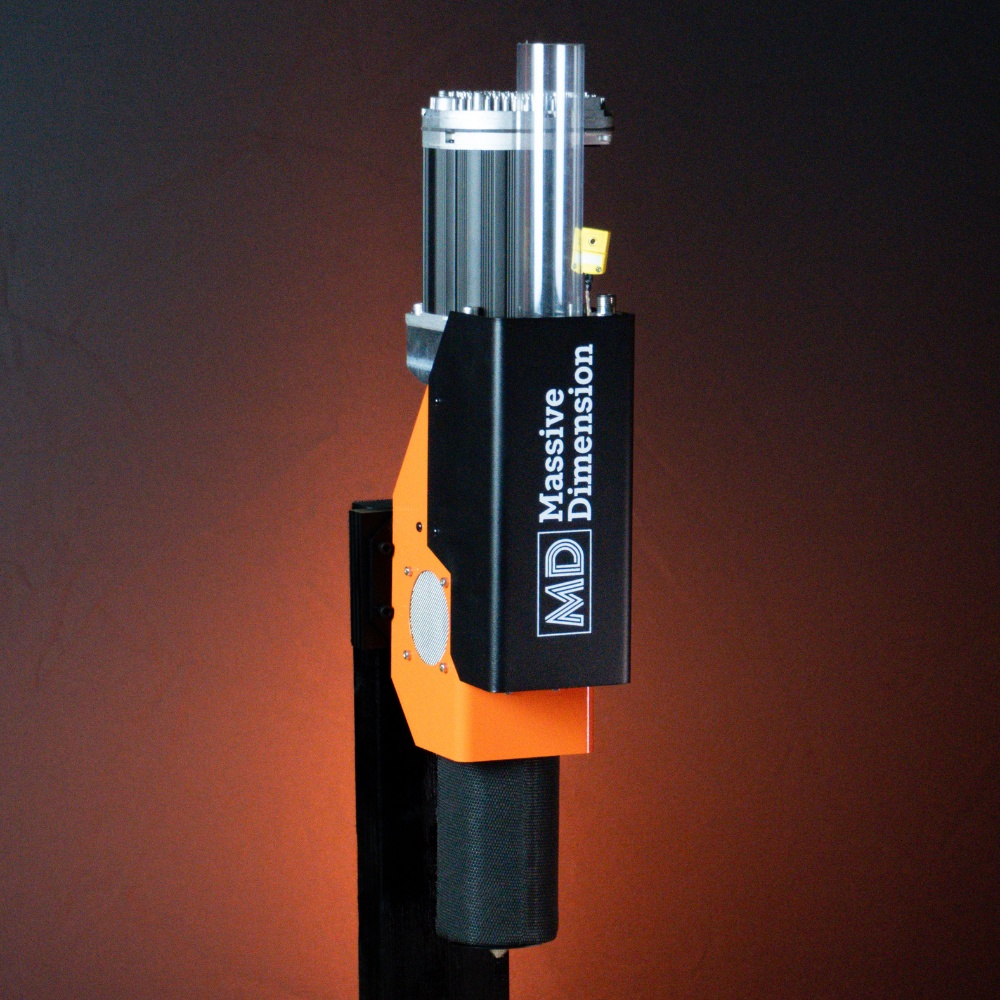
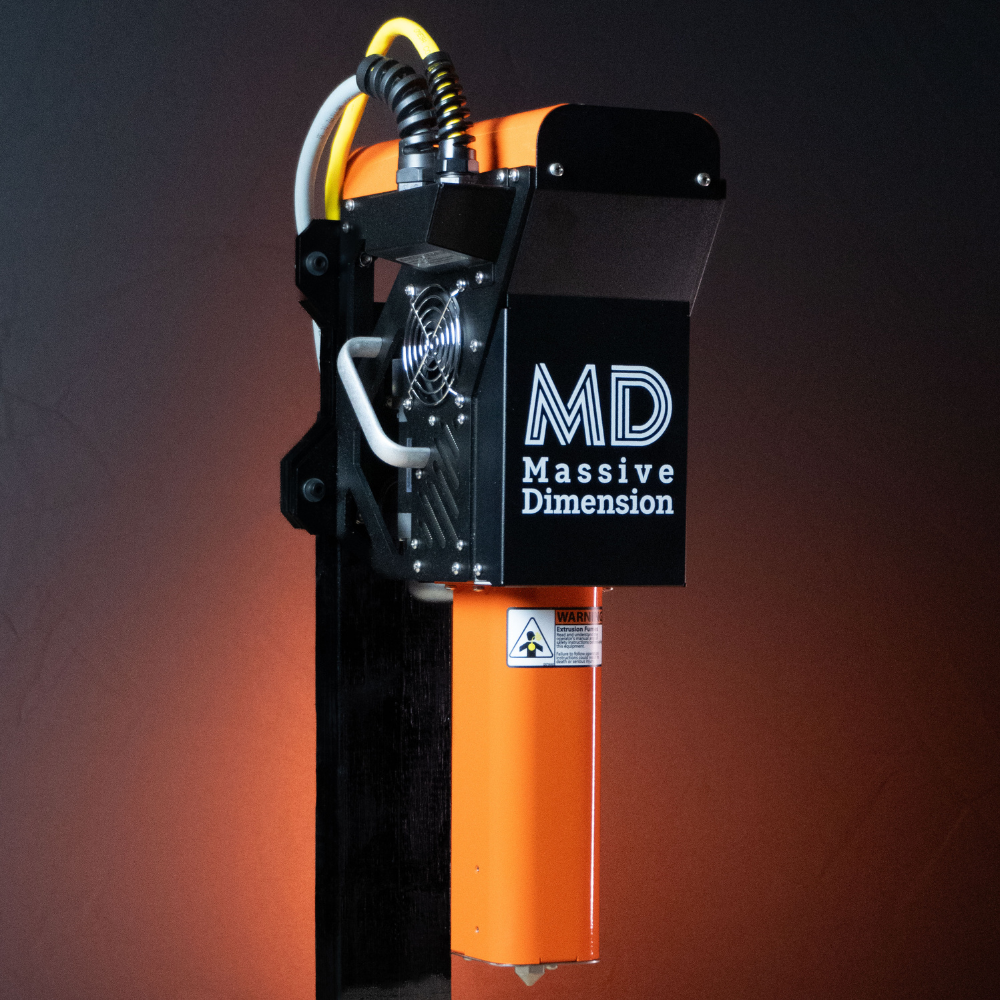
with MDPE10 extruder
UV-stabilized HDPE-GF
hull validation roadmap
The PRINTcess — World's Largest 3D-Printed Benchy
Before marine-grade LFAM becomes a production reality, someone had to prove a large-format pellet printer could actually build a boat. Dr. D-Flo did exactly that.


A functional boat. Printed with the MDPE10. It floats.
Benchy model
in recycled PETG
project cost
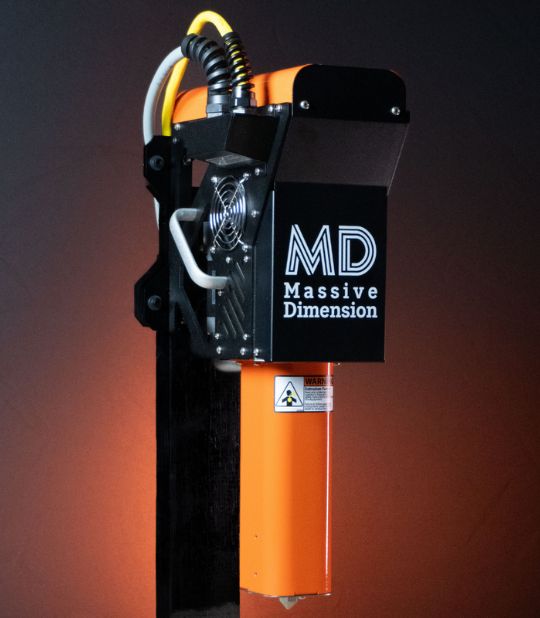
David Florian (Dr. D-Flo), a Ph.D. engineer and YouTube educator, spent 2.5 years building up to this project — first constructing his open-source large-format gantry printer, then iterating through multiple versions until the system could extrude 200 pounds of material per day. The key to hitting that throughput: the Massive Dimension MDPE10 pellet extruder.
The result — named the PRINTcess — is a fully registered, Tennessee-plated watercraft. It measures 10' × 3'4" × 8'1" and weighs 1,200 lbs including a 400 lb concrete keel for stability. The 500 lb hull was printed in three sections at 100 mm/s, 3mm extrusion width, and 2mm layer height, then bonded and float-tested before final assembly. It carries two adults on calm water under a 2HP electric trolling motor powered by LiFePO4 batteries and 200W of solar panels.
The PRINTcess is a 45:1 scale version of the Benchy model. The hull was printed in three separate pieces, measuring 3.3 ft wide and 10 ft long in total, using a MDPE10 extruder running at 200 pounds (90 kg) per day.
— Dr. D-Flo, drdflo.com — PRINTcess project documentationDr. D-Flo chose recycled PETG for the hull — noting in his documentation that while it worked, PETG is not ideal: its flexibility requires extra wall thickness for adequate stiffness, and its low melt viscosity makes large-width overhangs prone to sagging. His own documentation makes the case for a stiffer, more marine-appropriate material. That's exactly where MD's work on HDPE+GF picks up.
| Extruder | Massive Dimension MDPE10 |
| Hull material | Recycled PETG pellets |
| Print speed | 100 mm/s (75 mm/s visible surfaces) |
| Extrusion width | 3 mm |
| Layer height | 2 mm |
| Infill | 13% Archimedean Chord |
| Hull sections | 3 (bonded post-print) |
| Throughput | 200 lb / day |
| Total hull weight | ~500 lb printed plastic |
| Full vessel weight | 1,200 lb (inc. 400 lb concrete keel) |
| Overall dimensions | 10' L × 3'4" W × 8'1" H |
| Draft (2 persons) | 14" |
| Propulsion | 2HP electric trolling motor |
| Registration | State of Tennessee — fully road-legal |
Why PETG Was Just the Beginning
Dr. D-Flo's own documentation calls it out plainly: PETG isn't the ideal hull material. The next chapter for LFAM in marine applications runs through glass-fiber reinforced HDPE — and MD is actively working toward validating it.
RTP 703 CC UV — HDPE + 20% Glass Fiber, Chemically Coupled, UV Stabilized
Massive Dimension is working to validate RTP 703 CC UV from RTP Company (Winona, MN) — a high-density polyethylene compound with 20% short glass fiber reinforcement, chemical coupling for superior fiber-to-matrix adhesion, and UV stabilization for outdoor and marine exposure. RTP Company describes themselves as "Imagineering Plastics," specializing in custom-engineered thermoplastic compounds.
The chemical coupling in RTP 703 CC UV eliminates the need for a separate MAPE compatibilizer step — fiber adhesion is built into the compound. UV stabilization is integrated at the material level, providing inherent resistance to solar degradation without topcoat dependency. The compound processes at 193–232°C melt temperature, well within the operational range of MD's MDPE10 Industrial extruder.
RTP 703 CC UV vs. PETG for Hull Applications
Dr. D-Flo flagged the problem directly in his build documentation: PETG's flexibility forces thicker walls to achieve adequate stiffness, adding weight. For a production-intent hull, you need a material that is structurally stiff without excess thickness, hydrolytically stable (won't absorb water over time), and UV-resistant for outdoor exposure. PETG struggles on all three counts for serious marine use. RTP 703 CC UV is engineered to address all three — with chemical coupling and UV stabilization built into the compound at the material level.
| PETG (PRINTcess) | RTP 703 CC UV (Target) | |
| Tensile modulus | ~2,100 MPa | 3,792 MPa (ASTM D638) |
| Flexural strength | ~80 MPa | 61 MPa — but stiffer in practice due to GF |
| Water absorption | Moderate (~0.2%) | Very low — HDPE base (<0.01%) |
| UV resistance | Poor without additives | Integrated UV stabilizer — built-in |
| GF coupling method | N/A | Chemical coupling — no separate MAPE step |
| Melt temp | 220–250°C | 193–232°C (within MD extruder range) |
| Marine use precedent | None established | HDPE base = rotomolded hull standard |
Marine Validation Roadmap
MD is pursuing a structured three-stage path from material qualification through to validated boat hull geometry — each stage building on the last. Here's where things stand today.
Dr. D-Flo demonstrated that an MD-powered LFAM system can print a functional, registered watercraft hull at 45:1 Benchy scale — confirming throughput, geometry feasibility, and structural bonding approaches. The PRINTcess floats, carries passengers, and is road-registered in Tennessee.
MD is actively working to validate RTP 703 CC UV — RTP Company's chemically coupled, UV-stabilized HDPE + 20% glass fiber compound — on its extruder line. This stage confirms process temperature windows, screw configuration, throughput rates, and interlayer bond quality. Chemical coupling is built into the RTP compound, eliminating the need for a separate MAPE step. Key focus areas include warping behavior at hull-scale print lengths and layer adhesion in the FGF process vs. the injection molding data on the RTP datasheet.
With RTP 703 CC UV parameters confirmed, the next stage is printing and testing a small boat test geometry — evaluating watertightness across bonded sections, structural performance under hydrostatic load, UV exposure resistance, and interlayer bond integrity in a wet environment over time.
Full-scale hull production using validated RTP 703 CC UV parameters on the MDAC Industrial Series — targeting small workboat, skiff, and tender applications where the economics of tooling-free additive production offer a genuine advantage over rotomolding and fiberglass layup.
The Small Boat Test — RTP 703 CC UV Hull Validation Build
Once RTP 703 CC UV is validated on MD extruders, this is the proposed test geometry: a small, flat-bottom skiff designed specifically to evaluate material performance in a real marine environment — not a lab specimen, an actual boat.
Validate RTP Company's RTP 703 CC UV — HDPE + 20% glass fiber, chemically coupled, UV stabilized — on the MD MDPE10 Industrial extruder mounted on an ABB IRB 4600. Establish confirmed process parameters, verify interlayer bond strength via tensile coupon testing, and characterize warping behavior at print lengths relevant to hull sections. The build setup uses both a heated build surface and a weld table to manage thermal management and adhesion at hull scale. Chemical coupling is integral to the compound; no separate compatibilizer step required.
Print a simplified flat-bottom skiff hull in RTP 703 CC UV using validated Stage 1 parameters. Target geometry chosen for printability: straight runs, minimal overhangs, continuous perimeter strategy. Hull designed in 2–3 sections for bonding evaluation. Target: float test + 2-person static load.
Float test, hydrostatic load test, UV exposure panel testing, and wet/dry cycle evaluation on bonded seam samples. Success criteria: watertight hull, structural integrity under 2-person static load, no delamination at bonded sections after accelerated UV exposure, and acceptable water absorption rate after 30-day immersion.
Why Large-Format Additive for Marine
The marine industry has long relied on fiberglass layup and rotomolding for hull production — both tooling-intensive, labor-intensive processes with long lead times. LFAM changes the fundamental economics.
A fiberglass hull requires a plug and a mold before a single part is made. An LFAM hull prints directly from CAD. For custom, low-volume, or one-off vessels, that difference in tooling cost can be the entire margin of a project.
Change a hull line, a transom angle, or a beam width between prints — at zero additional tooling cost. For working vessels, custom tenders, or design validation before production tooling, this changes what's possible in early-stage development.
HDPE is the most widely used material in rotomolded boat hull production globally. RTP 703 CC UV brings a chemically coupled, UV-stabilized version of that same HDPE base into a pellet format validated for large-format additive — not uncharted material territory, but a proven marine base material in a new process.
Printed hulls can incorporate internal structural features, integrated ribs, cable runs, and built-in flotation chambers directly in the print — features that rotomolding and fiberglass layup can only approximate through secondary bonding or assembly.
At hull scale, material cost dominates. Pellet feedstock runs 50–75% less than filament. HDPE-based engineered compounds like RTP 703 CC UV are standard industrial materials — available at costs that make large printed structures economically viable compared to fiberglass layup labor.
Robotic cells enable non-planar toolpaths that follow hull curvature — printing along the surface rather than in flat horizontal layers. This improves interlayer bond strength at critical locations like the keel and chine, and reduces the stair-step artifact on curved surfaces.

Working in Marine Fabrication?
Let's Talk.
MD is actively building out its marine capability — from material validation to hull geometry testing. If you're in the marine industry and want to explore what large-format additive could do for your production, we want to hear from you. Early collaborators will shape where this goes.