

Furniture & Fixtures
not weeks
filament feedstock
print orientations
design change
Furniture & Fixtures in the Field
See how studios and fabricators are already using MD systems to produce large-scale custom pieces — at the speed and economics traditional methods can't touch.
 Customer Spotlight
From 3–5 weeks to 3–6 days — prop & fixture fabrication for Hollywood
fabrication workflow
mm/s
with MDAC Industrial
in-house cell
Innovation Workshop (IWS) builds large-scale props and set pieces for major Hollywood productions — including Avatar: The Way of Water, Black Adam, Transformers: Rise of the Beasts, The Matrix Resurrections, and Jungle Cruise. Their robotic arm was originally purchased for on-set animation work. When it wasn't on set, it sat idle — until 3D & Robotics Supervisor Andrew Hyde started exploring what else it could do.
They evaluated traditional approaches including foam carving, but chose large-format additive manufacturing. The MDAC Industrial Series — running at 200 mm/s with upgraded motors and optimized gear ratios — replaced a workflow that previously required multi-part design, manual sculpting or machining, mold creation, casting, and final assembly. That process took 3–5 weeks per large prop. The MDAC workflow takes 3–6 days.
"Everyone's trying to always figure out how to do something better, quicker, cheaper, faster. Usually, you don't get all four of those things. You get a pair. With this, we got all four, mainly speed."
— Andrew Hyde, 3D & Robotics Supervisor, Innovation Workshop"With everything here, we can control how quickly everything goes out, the quality, and we can change things on the fly. Basically, that's why we chose to have it in-house."
— Andrew Hyde, 3D & Robotics Supervisor, Innovation Workshop"We had amazing support from Massive Dimension with their support team. So anytime we had a question, we had someone to call quickly and get an answer to."
— Andrew Hyde, 3D & Robotics Supervisor, Innovation WorkshopCustom retail fixture fabrication — 200 Trunks Exhibition, NYC
In celebration of the Louis Vuitton 200 Trunks exhibition at 660 Madison Avenue, New York, the MD team developed a custom robotic printing configuration to produce a series of large decorative letter forms for the retail display.
Using an ABB IRB4400 robot arm and a purpose-built angled build surface fixture, the letters were printed in a custom orientation that required zero modification to the original CAD geometry — all back surfaces were self-supported during the build. One letter per 3–4 hours, running live on the showroom floor during store hours.
By leveraging the advantages of robotic printing, a custom-positioned build surface fixture was created for this retail display. This build orientation required no changes to the original CAD models, as all the back surfaces are supported during the build process.
— Massive Dimension MD Project
Why MD for Furniture & Fixtures
Robotic pellet extrusion removes the constraints that have historically made custom furniture and fixture fabrication slow and expensive.
Organic profiles, compound curves, and open lattice structures print directly from CAD — no molds, no jigs, no setup fees per design iteration. Every piece can be geometrically unique at zero additional cost.
From digital file to finished part in days. Single-piece large-format production eliminates the multi-step assembly workflows that stretch traditional furniture fabrication to weeks — critical for exhibition, event, and retail timelines.
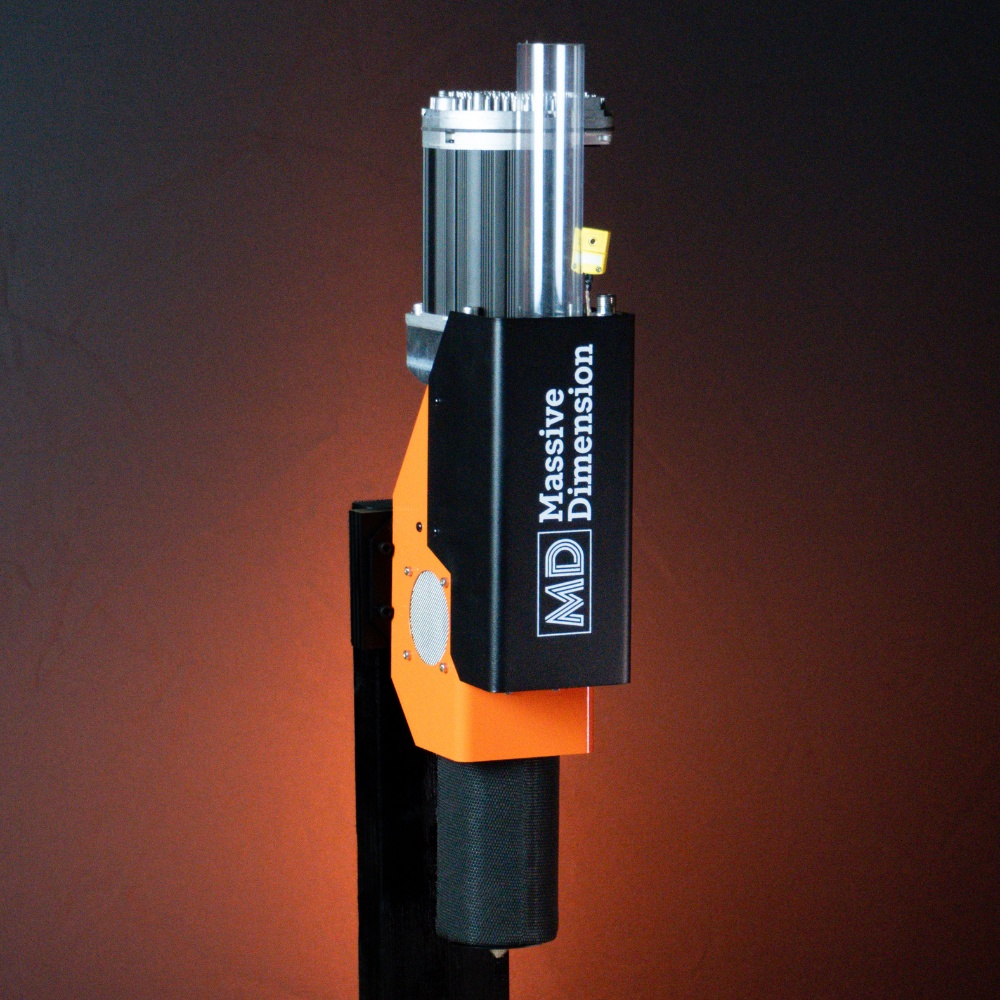
Pellet feedstock costs 50–75% less than filament. At furniture scale, that difference makes large-format additive economically viable for production runs — not just one-off prototypes or concept pieces.
PLA, ABS, PETG, TPU, PC, and fiber-reinforced composites — match the structural and finishing requirements of each application, from lightweight exhibition props to load-bearing furniture components.
Non-planar and multi-planar toolpaths enable surface cladding, contour-conforming prints, and custom build orientations not achievable on gantry systems — unlocking fixture geometries that would otherwise require complex multi-piece assembly.
Every piece can be unique at no additional tooling cost — enabling made-to-spec furniture, branded retail fixtures, and bespoke exhibition pieces at production scale. When there are no molds to cut, customization is free.
More Customer Stories
We're actively documenting how MD customers are applying large-format additive to furniture production, retail fixture fabrication, and interior design. Know a studio using MD hardware in this space? Get in touch →
Production-run seating, tables, and shelving with per-piece customization — no mold costs.
In-store displays, branded millwork, and point-of-sale installations on rapid turnaround.
Built-in fixtures, sculptural elements, and bespoke architectural components for commercial interiors.
Trade show environments, museum installations, and temporary display structures — print, install, recycle.


Print at Furniture Scale.
Talk to our application engineers about which MD system fits your production volume, material requirements, and print envelope. From entry-level cobots to full industrial cells — we'll spec the right solution.